
Success story
Last updated: May 2026
Buy Houses Japan: find property in Japan using AI
Buy Houses Japan is a live bilingual property search app built and operated by Urbano DX. A buyer types one sentence, the app turns it into editable structured filters, and results land in a card list next to a map with price pins. Coverage spans Kanto, Kansai, and Kyushu, with EN and 日本語 interfaces, USD or JPY prices, and sqft or m2 units.
Buyer Guide
How to review Buy Houses Japan: find property in Japan using AI
Buy Houses Japan: find property in Japan using AI is a proof asset: it shows how Urbano DX expects software and AI sprints to be scoped, reviewed, delivered, and handed over. The point is to replace vague promises with concrete artifacts a buyer can inspect.
When reviewing a proof asset, look past the surface. The important questions are whether acceptance criteria, data assumptions, risks, ownership, and the next decision are clear. A good sprint output supports procurement and business review, not just a nice demo.
Use this page before a first call to align expectations. It helps buyers know which materials to prepare, how to judge a demo, and what should remain useful after the sprint ends.
Evidence to inspect
Working surface, demo path, risks, assumptions, and acceptance criteria.
Internal use
Procurement, budget approval, security review, and next-scope planning.
Good output
Something reusable, handover-ready, and clear enough to explain.
What it is
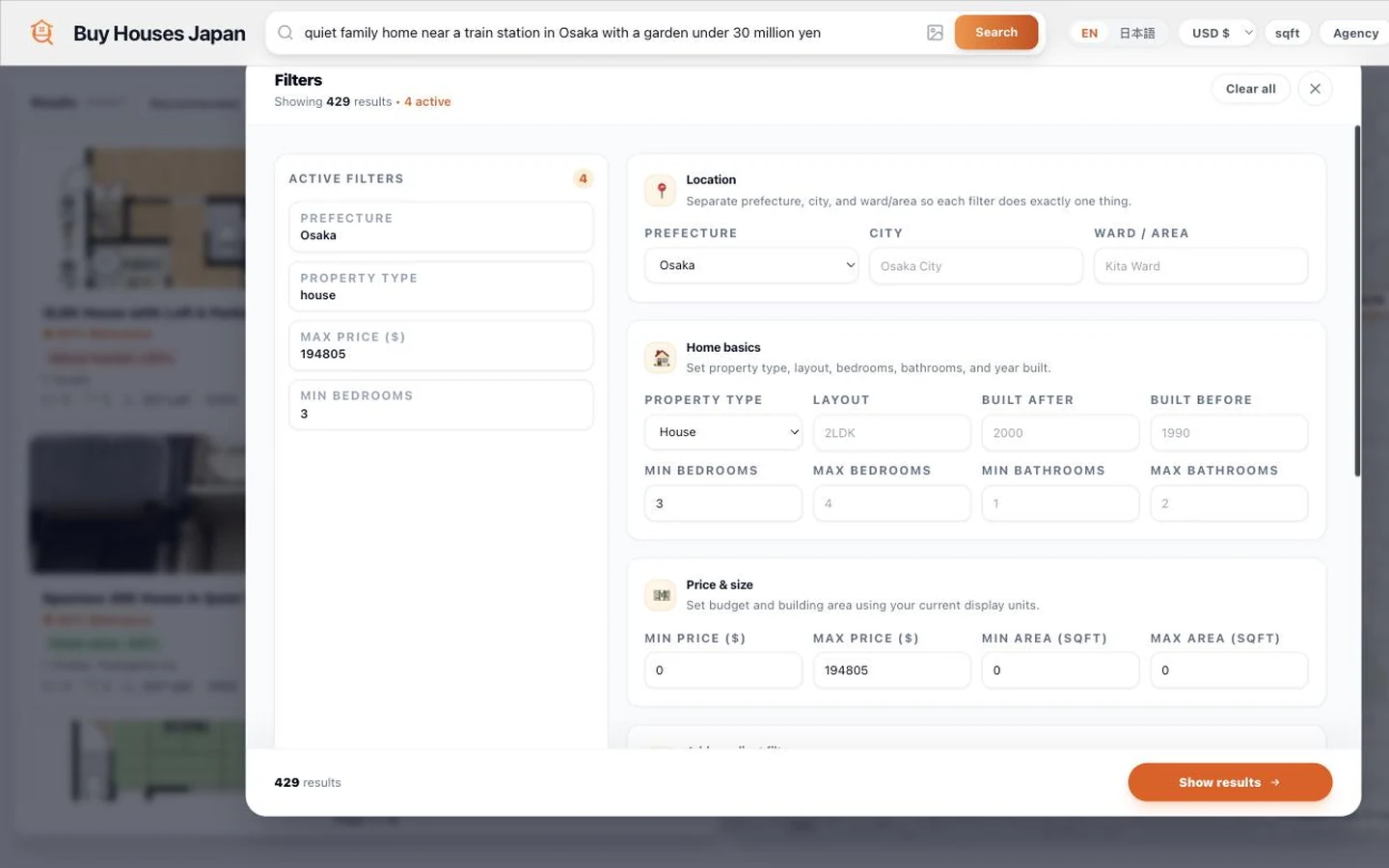
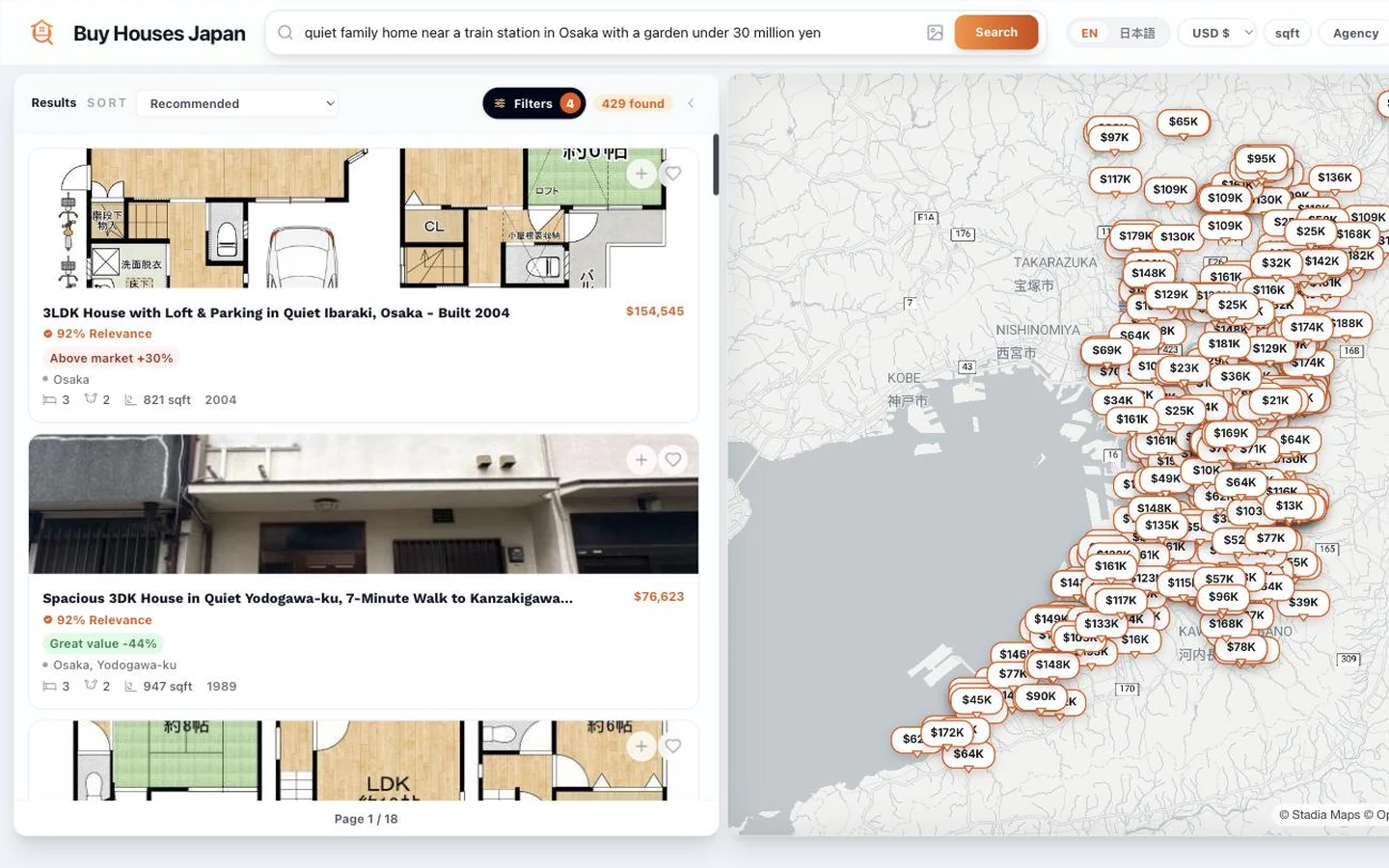
A buyer writes something like "quiet family home near a train station in Osaka with a garden under 30 million yen". The app parses that into structured filters, shows them as editable fields, and runs the search. That exact query returns 429 matching listings across 18 pages, with prefecture, property type, maximum price, and minimum bedrooms filled in and open to correction.
- Plain-sentence search parsed into editable filters
- 429 results on the sample query, paginated over 18 pages
- Card list beside a map with price pins
- Bilingual EN and 日本語, USD or JPY, sqft or m2
What was built
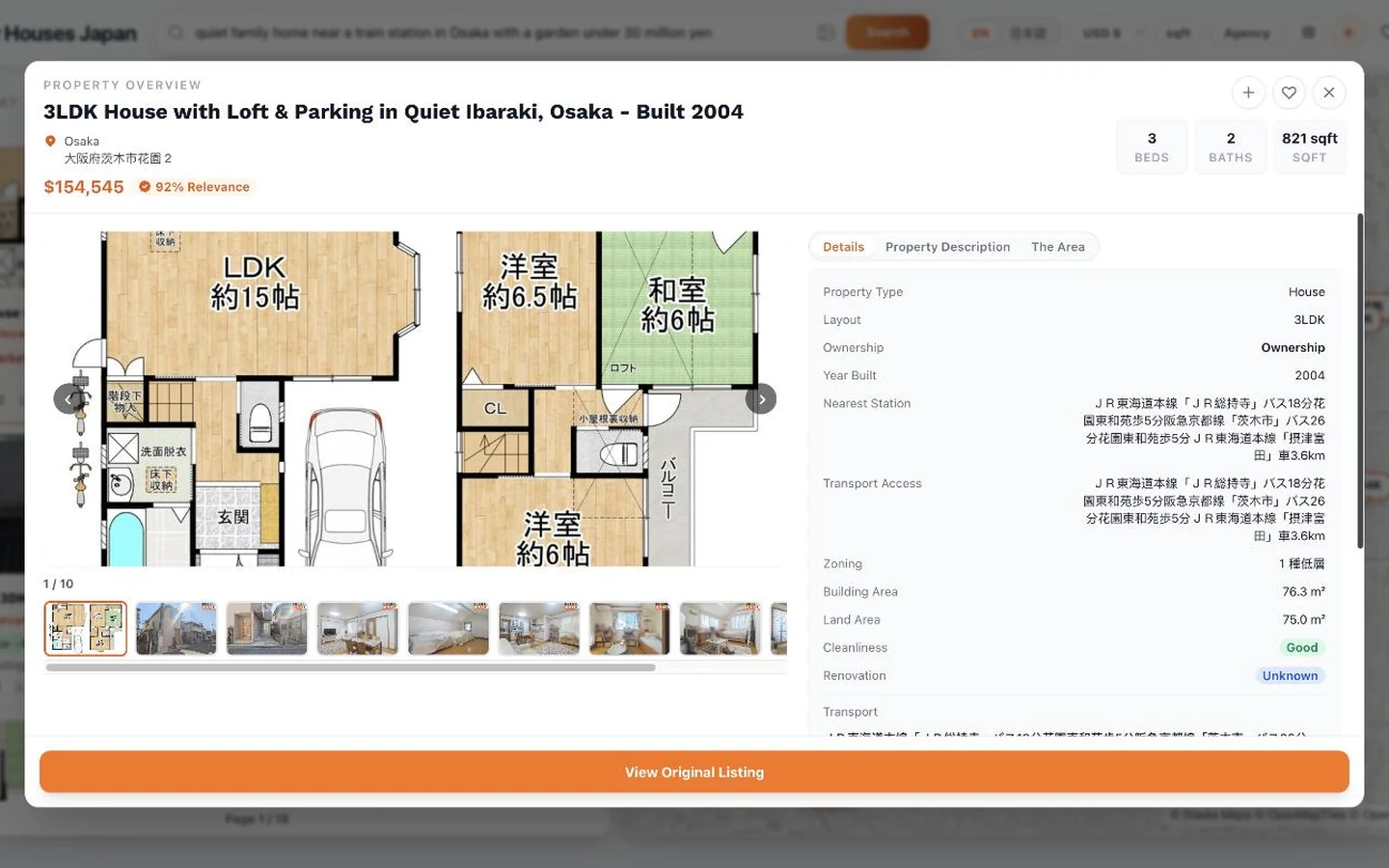
Listings come from major Japanese portals through scheduled ingestion pipelines, then get normalized into consistent fields: property type, layout such as 3LDK, ownership, year built, nearest station and transport access kept in Japanese, zoning, and building and land area in m2. On top of that, each listing carries derived signals: a relevance score, a market read against comparable prices, and condition flags.
- Front end: React 18 and Vite, built with Bun, maps via MapLibre GL
- Back end: FastAPI on MongoDB, with zvec for semantic search
- Ingestion: Prefect pipelines scraping AtHome and Nifty
- Firebase for auth, Stripe for payments, LLM calls through a shared gateway
What it demonstrates
The pattern travels well beyond real estate. Messy user intent becomes structured criteria the user can see and override, noisy source data becomes normalized records, and the model output stays advisory rather than hidden. Urbano DX built, shipped, and operates the whole surface, which is the same discipline applied to paid PoCs and MVP sprints.
- Intent to structured filters, always editable
- Messy Japanese source data normalized into usable fields
- Derived signals shown as signals, not verdicts
- A live product to inspect, not a slide deck
Scope the first sprint
Bring the app, API, LLM feature, or AI workflow you want to test. We will turn it into a clear first-sprint scope.
Start a conversation