
News
OpenAI Will Remove gpt-image-2 From Its API on 10 February 2027: What to Change in Your Image Workflows
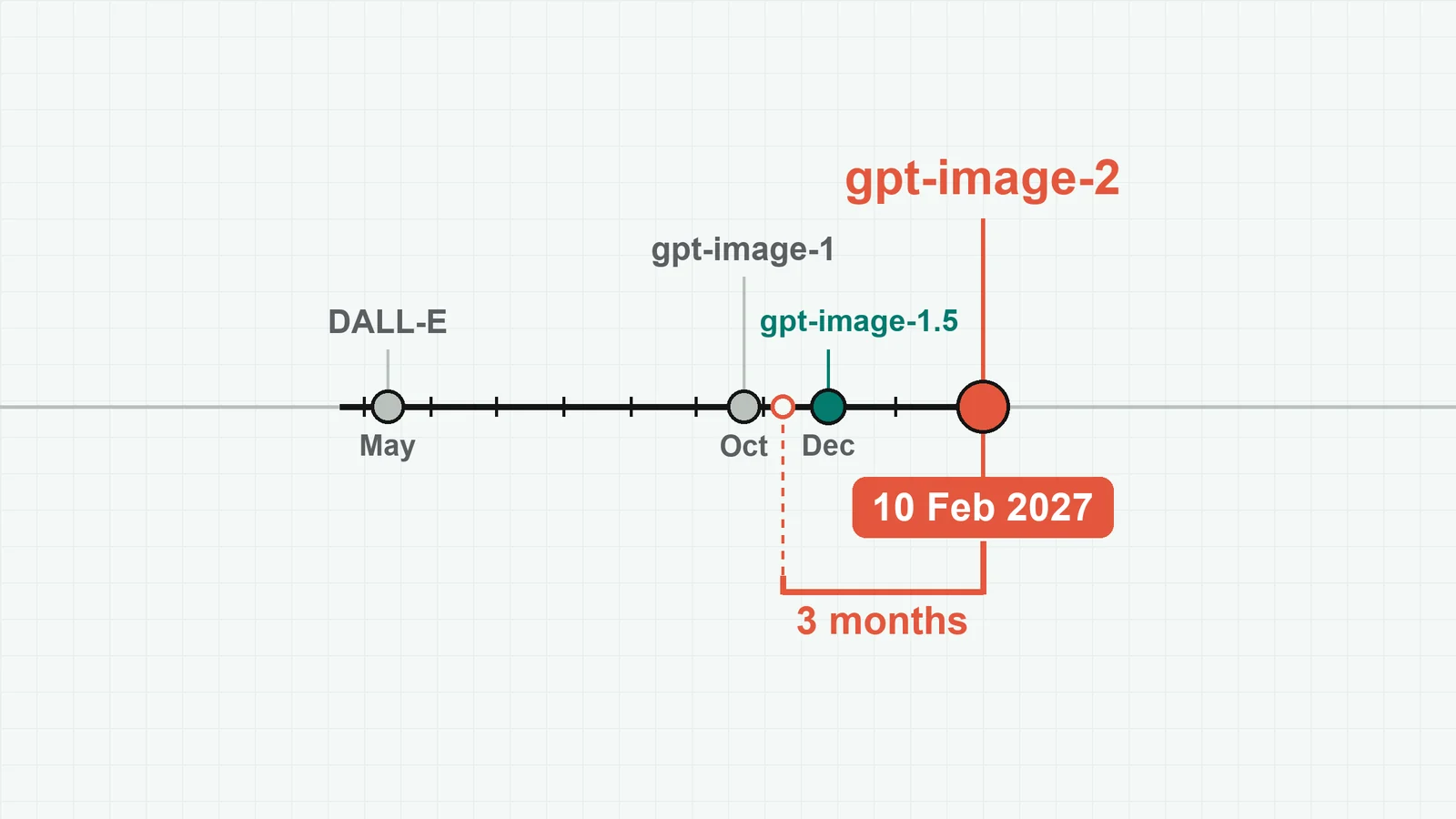
OpenAI added an entry dated 10 November 2026 to its API deprecations page: the gpt-image-2 model and its gpt-image-2-2026-04-21 snapshot "are deprecated and will be removed from the API on February 10, 2027" [1]. The page gives dates only, no times. The recommended replacements are gpt-image-2.6-sunburst or gpt-image-2.6-flare [1], released on 4 November for image generation and edits [3].
The one thing to know: OpenAI promises at least three months' notice for image generation models, against six for generally available ones, and this notice is exactly three months [1]. After the shutdown the model "will no longer be accessible" [1], so every job that names it needs a change before 10 February.
What changed
- Both names go. The alias and the dated snapshot go on the same day, so pinning the snapshot does not help; the model page already reads "Status: Deprecated" [1][2].
- Same token rates. Per million tokens, OpenAI lists $5 for text input, $8 for image input and $30 for image output on
gpt-image-2and both 2.6 models [4][5][6]. Our own OpenRouter price snapshot of 9 November 2026 agrees [8]. But OpenAI's guide says the models can use different token counts for the same quality setting [7], so cost per image can move. - No Batch on 2.6.
gpt-image-2supports the Batch API at half price, $15 per million image output tokens [2][3][6]. Both 2.6 model pages list Batch as "Not supported", and the Batch price table has no 2.6 rows [4][5][6]. - New defaults. The 2.6 models add a
complexityfield that defaults tohigh; OpenAI says higher complexity "can increase latency and introduce unwanted changes" [7]. - No dated 2.6 snapshot. Each 2.6 page lists only the alias itself as its snapshot [4][5].
Key dates
| When | What |
|---|---|
| 21 Apr 2026 | gpt-image-2 released, with Batch at a 50% discount [3] |
| 12 May 2026 | DALL-E 2 and DALL-E 3 removed [1] |
| 23 Oct 2026 | gpt-image-1 shut down [1] |
| 4 Nov 2026 | GPT Image 2.6 Sunburst and Flare released [3] |
| 10 Nov 2026 | gpt-image-2 deprecated; time not stated [1] |
| 1 Dec 2026 | gpt-image-1-mini, gpt-image-1.5 and chatgpt-image-latest removed [1] |
| 10 Feb 2027 | gpt-image-2 and gpt-image-2-2026-04-21 removed; time not stated [1] |
| Not yet decided | Any extension beyond dedicated capacity through OpenAI's sales team [1] |
What it means for your systems
Where the calls hide. In a firm of 10 to 250 people, image calls sit in several places: a catalogue image script, a back-office job that renders labels or documents through v1/images/edits, a marketing content tool, a no-code automation step, and third-party tools that wrap OpenAI with your key or theirs.
Find every call. Search code, config and environment files for gpt-image-2; the string also matches the 2.5 and 2.6 names, so read each hit. Open each automation by hand. Ask every vendor that makes images for you which model it calls and when it moves.
One value, not ten. Keep the model name in one config value per job, so moving and rolling back are config changes.
Watch the date in code. OpenAI emails customers "actively using the model" [1]; that may not be whoever maintains the job. The List models endpoint (GET /v1/models) carries an optional shutdown_date field [1]: a weekly check that alerts on any model you use is a few lines.
Test on your own inputs. Run real prompts and, for edits, real input images and masks through both 2.6 models. Compare output, latency and the tokens per image the response reports. Set complexity explicitly. If a job runs through Batch, price the same volume at standard rates first.
What is not decided yet
Not stated in anything we read: the time of the announcement or of the shutdown; published tokens per image for each 2.6 model, beyond the guide's interactive estimate [7]; whether 2.6 gets dated snapshots or Batch support; whether 2.6 works in the Responses API image generation tool, as gpt-image-2 does [3]; and whether size limits and edit fidelity match gpt-image-2, since the guide's size section names only the 2.5 models [7]. On extensions, the page offers only that some developers "may be able to provision dedicated capacity" [1].
Our take
Opinion. gpt-image-2 will have lasted under ten months, from 21 April 2026 to 10 February 2027 [1][3], and image models get half the minimum notice of generally available ones [1]: treat the model name as a part that expires. The cheap fix is structural: one config value, a weekly shutdown_date check, and a saved set of real prompts and edit inputs to rerun at the next notice. If your volume runs through Batch, the documented replacements cost twice as much per token today, so price the move before you make it.
Sources
All read on 10 November 2026; times are UTC.
- OpenAI, "Deprecations", API documentation: the 2026-11-10 GPT Image 2 entry, replacements, the notice periods, email notice, "no longer be accessible", the
shutdown_datefield, dedicated capacity, and the 2025-11-14, 2026-04-22 and 2026-06-02 image entries. https://developers.openai.com/api/docs/deprecations (read 15:00 through its .md version) - OpenAI, "GPT-Image-2" model page: Status Deprecated, default snapshot
gpt-image-2-2026-04-21, Batch supported. https://developers.openai.com/api/docs/models/gpt-image-2 (read 15:01) - OpenAI, API changelog: 21 April 2026 release of GPT Image 2 with Batch at a 50% discount; 20 August 2026 entry on
gpt-image-2in the Responses API image generation tool; 4 November 2026 release of the 2.6 models forv1/images/generationsandv1/images/edits. https://developers.openai.com/api/docs/changelog (read 15:01) - OpenAI, "GPT-Image-2.6 Sunburst" model page: token prices, the alias as default and only snapshot, Batch not supported. https://developers.openai.com/api/docs/models/gpt-image-2.6-sunburst (read 15:01)
- OpenAI, "GPT-Image-2.6 Flare" model page: the same points for Flare. https://developers.openai.com/api/docs/models/gpt-image-2.6-flare (read 15:01)
- OpenAI, "Pricing", image generation: standard rates for all three models, Batch rates for
gpt-image-2and no 2.6 Batch rows. https://developers.openai.com/api/docs/pricing (read 15:01) - OpenAI, "Image generation" guide: the
complexitydefault and its effect, different token counts per model, the size section for the 2.5 models,gpt-image-2input fidelity, the interactive cost calculator. https://developers.openai.com/api/docs/guides/image-generation (read 15:01) - Urbano DX model price records, OpenRouter snapshot of 9 November 2026: rate lines for
openai/gpt-image-2,openai/gpt-image-2.6-sunburstandopenai/gpt-image-2.6-flare, each marked partial in our file. (read 15:04)
How we made this: drafted with AI tools from the primary sources listed above, then checked fact by fact against those sources in a separate review, also AI-assisted, on 10 Nov 2026. Opinion is labelled "Our take". This is a source-based report, not a hands-on test.